
Africa’s 54 Countries and the ESG Imperative: Why the Next Strategic Partnership Must Be Africa × GCC
Author: Teresa Apolónia,
CEO & Transformation Leader at ESG ACCESS - Portugal
CEO & Transformation Leader at ESG ACCESS - Portugal
Date: 19/1/2026
“Africa” is often treated as a single headline: a single risk profile, a single growth story, a single ESG debate. Yet Africa is 54 countries, each with its own institutions, political economy, regulatory trajectory, demographic pressure, climate exposure, and investment logic. If ESG is meant to be a framework for disciplined decision-making—not a marketing label—then the starting point must be clear: there is no single African ESG narrative. There is an African ESG mosaic.
That mosaic matters now more than ever. Africa’s demographics are reshaping the global labor and consumption map. Its natural capital—forests, biodiversity, watersheds, coastlines—has planetary relevance. Its mineral endowments are central to the energy transition. Its cities are expanding at a scale that will define tomorrow’s infrastructure, mobility, and resilience. At the same time, African states, regional institutions, pension funds, development banks, and private investors are increasingly active as capital providers, not merely as project hosts.
In parallel, the GCC is refining its global economic positioning through diversification, infrastructure leadership, logistics corridors, energy transformation, sovereign investment capacity, and a growing focus on sustainability outcomes.
A strategic question therefore emerges with urgency:
Can Africa’s own investment capacity, development priorities, and institutional agendas converge with GCC capital and capabilities to generate credible, bankable, and governed ESG outcomes—at scale?
This does not mean standards are irrelevant. It means they must be applied intelligently, with proportionality and local anchoring. For example:
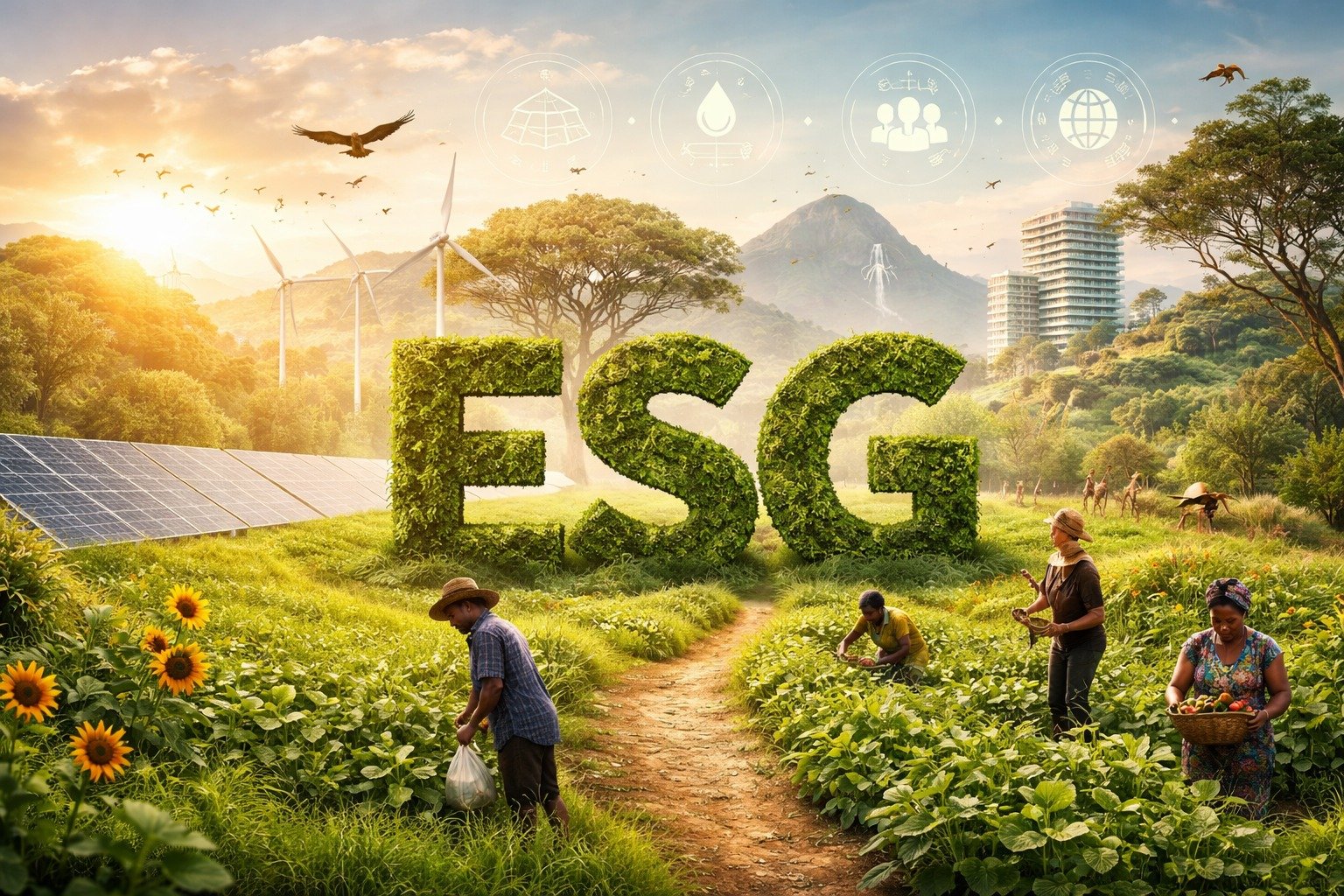
• Environmental materiality may be about climate resilience, drought management, coastal adaptation, or methane reduction—before it is about sophisticated decarbonization reporting.
• Social materiality is frequently about livelihoods, community impact, land use, labor conditions in supply chains, and equitable access to essential services.
• Governance is often the determining factor: procurement integrity, permitting clarity, dispute resolution, contract stability, and enforcement capacity.
Across the 54 countries, ESG is therefore not a uniform “score.” It is a set of managed trade-offs, negotiated by governments, investors, communities, and institutions. The quality of those trade-offs depends on how investments are structured, monitored, and governed—including by African public and private actors themselves.
1. Energy access and transition
Africa’s energy challenge is not only decarbonization—it is electrification. Grid upgrades, distributed renewables, storage, and transitional solutions can mobilise state-owned utilities, local banks, pension funds, DFIs, and international partners around shared ESG outcomes.
2. Resilient cities and infrastructure
Urban growth demands transport, housing, waste systems, and climate-resilient construction. Here, ESG is practical and frequently driven by municipal authorities, national infrastructure agencies, and local developers, alongside external capital.
3. Food, water, and climate adaptation
Agricultural value chains, cold logistics, irrigation efficiency, and drought resilience increasingly involve African agribusinesses, cooperatives, regional funds, and public programmes, structured to attract additional capital.
4. Nature-based value and biodiversity integrity
Forest protection, mangrove restoration, and watershed services require strong public governance and local custodianship, complemented—but not replaced—by external finance.
5. Critical minerals and responsible supply chains
Africa’s role in the global energy transition is inseparable from national resource strategies, state participation, and domestic value-addition ambitions, with ESG as a condition for long-term legitimacy.
Each corridor looks different in each country. That is precisely the point: Africa is not one project; it is 54 policy and investment environments, many of which already deploy capital internally.
The GCC is uniquely positioned to act as a strategic partner and co-investor, bringing scale, long-term horizons, infrastructure expertise, logistics capability, and energy-system know-how. The opportunity lies not in replacing African capital, but in aligning it, enhancing bankability, and strengthening governance frameworks.
This alignment requires:
• project preparation and structuring that accommodates multiple capital sources;
• ESG risk and governance frameworks compatible with both African institutional realities and international expectations;
• credible due diligence, monitoring, and execution capacity across public–private interfaces.
This is where ESG Access plays a central role.
ESG Access operates as an execution and governance partner, ensuring that African public authorities, local investors, regional institutions, and GCC partners can operate within a shared ESG architecture.
Its role spans the full lifecycle:
• At strategy level, supporting governments and institutions in designing ESG-aligned national or sectoral frameworks consistent with development priorities and capital-market expectations.
• At project level, embedding ESG-by-design in energy, infrastructure, logistics, security systems, industrial assets, and nature-based projects—ensuring bankability, governance integrity, and social legitimacy.
• At investment level, supporting ESG due diligence, risk mapping, monitoring, and reporting across mixed capital structures without disconnecting from local feasibility.
Through this integrated approach, ESG becomes a coordination tool between African capital and international partners, not a constraint imposed from outside.
The GCC does not need Africa as a headline. It needs Africa as a strategic partner, capable of co-investing, co-governing, and co-delivering resilient infrastructure, sustainable energy systems, responsible supply chains, and nature-positive development.
The opportunity is not to “apply ESG to Africa.”
The opportunity is to co-create ESG solutions with Africa, aligning domestic and international capital within robust governance frameworks.
This is what makes ESG executable across Africa’s 54 countries—and investable for GCC partners.
That mosaic matters now more than ever. Africa’s demographics are reshaping the global labor and consumption map. Its natural capital—forests, biodiversity, watersheds, coastlines—has planetary relevance. Its mineral endowments are central to the energy transition. Its cities are expanding at a scale that will define tomorrow’s infrastructure, mobility, and resilience. At the same time, African states, regional institutions, pension funds, development banks, and private investors are increasingly active as capital providers, not merely as project hosts.
In parallel, the GCC is refining its global economic positioning through diversification, infrastructure leadership, logistics corridors, energy transformation, sovereign investment capacity, and a growing focus on sustainability outcomes.
A strategic question therefore emerges with urgency:
Can Africa’s own investment capacity, development priorities, and institutional agendas converge with GCC capital and capabilities to generate credible, bankable, and governed ESG outcomes—at scale?
ESG in Africa: less about labels, more about baselines
In many African contexts, ESG cannot be reduced to compliance checklists imported from elsewhere. The most material ESG questions often begin with fundamentals: energy access, water security, food systems, basic infrastructure, jobs, health, education, and institutional capacity. Where ESG frameworks are applied without understanding these baselines, the result is predictable: mispricing of risk, unrealistic reporting expectations, and investment designs that fail in implementation.This does not mean standards are irrelevant. It means they must be applied intelligently, with proportionality and local anchoring. For example:
• Environmental materiality may be about climate resilience, drought management, coastal adaptation, or methane reduction—before it is about sophisticated decarbonization reporting.
• Social materiality is frequently about livelihoods, community impact, land use, labor conditions in supply chains, and equitable access to essential services.
• Governance is often the determining factor: procurement integrity, permitting clarity, dispute resolution, contract stability, and enforcement capacity.
Across the 54 countries, ESG is therefore not a uniform “score.” It is a set of managed trade-offs, negotiated by governments, investors, communities, and institutions. The quality of those trade-offs depends on how investments are structured, monitored, and governed—including by African public and private actors themselves.
Where Africa’s ESG is investable now
Despite complexity, Africa is not “un-investable.” It is investable where ESG is translated into outcomes, incentives, and credible governance mechanisms, often through co-investment models combining domestic and international capital. Several corridors stand out:1. Energy access and transition
Africa’s energy challenge is not only decarbonization—it is electrification. Grid upgrades, distributed renewables, storage, and transitional solutions can mobilise state-owned utilities, local banks, pension funds, DFIs, and international partners around shared ESG outcomes.
2. Resilient cities and infrastructure
Urban growth demands transport, housing, waste systems, and climate-resilient construction. Here, ESG is practical and frequently driven by municipal authorities, national infrastructure agencies, and local developers, alongside external capital.
3. Food, water, and climate adaptation
Agricultural value chains, cold logistics, irrigation efficiency, and drought resilience increasingly involve African agribusinesses, cooperatives, regional funds, and public programmes, structured to attract additional capital.
4. Nature-based value and biodiversity integrity
Forest protection, mangrove restoration, and watershed services require strong public governance and local custodianship, complemented—but not replaced—by external finance.
5. Critical minerals and responsible supply chains
Africa’s role in the global energy transition is inseparable from national resource strategies, state participation, and domestic value-addition ambitions, with ESG as a condition for long-term legitimacy.
Each corridor looks different in each country. That is precisely the point: Africa is not one project; it is 54 policy and investment environments, many of which already deploy capital internally.
Why the Africa × GCC partnership still matters
Recognising Africa’s own investment capacity does not diminish the relevance of the GCC. On the contrary, it reframes the relationship.The GCC is uniquely positioned to act as a strategic partner and co-investor, bringing scale, long-term horizons, infrastructure expertise, logistics capability, and energy-system know-how. The opportunity lies not in replacing African capital, but in aligning it, enhancing bankability, and strengthening governance frameworks.
This alignment requires:
• project preparation and structuring that accommodates multiple capital sources;
• ESG risk and governance frameworks compatible with both African institutional realities and international expectations;
• credible due diligence, monitoring, and execution capacity across public–private interfaces.
This is where ESG Access plays a central role.
ESG Access as the enabler of multi-capital ESG execution
All strategies, steps, and project types discussed in this article—governmental or private, domestically financed, regionally supported, or internationally co-invested—can be designed, structured, governed, and executed through ESG Access.ESG Access operates as an execution and governance partner, ensuring that African public authorities, local investors, regional institutions, and GCC partners can operate within a shared ESG architecture.
Its role spans the full lifecycle:
• At strategy level, supporting governments and institutions in designing ESG-aligned national or sectoral frameworks consistent with development priorities and capital-market expectations.
• At project level, embedding ESG-by-design in energy, infrastructure, logistics, security systems, industrial assets, and nature-based projects—ensuring bankability, governance integrity, and social legitimacy.
• At investment level, supporting ESG due diligence, risk mapping, monitoring, and reporting across mixed capital structures without disconnecting from local feasibility.
Through this integrated approach, ESG becomes a coordination tool between African capital and international partners, not a constraint imposed from outside.
Conclusion
Africa’s 54 countries do not need ESG as a slogan. They need ESG as a discipline for designing investments that work—for people, ecosystems, and long-term economic stability. Africa is not merely a destination for capital; it is an active investor, regulator, and co-architect of its own development pathways.The GCC does not need Africa as a headline. It needs Africa as a strategic partner, capable of co-investing, co-governing, and co-delivering resilient infrastructure, sustainable energy systems, responsible supply chains, and nature-positive development.
The opportunity is not to “apply ESG to Africa.”
The opportunity is to co-create ESG solutions with Africa, aligning domestic and international capital within robust governance frameworks.
This is what makes ESG executable across Africa’s 54 countries—and investable for GCC partners.






 Advertisement
 Advertisement
 Advertisement
Dubai Headquarters
Opal Tower, Business Bay,
10th Floor
Dubai
International Offices
Luanda - Angola


- © 2026 Copyright Africa GCC - Council
- Disclaimer
Powered By
